The heart of the Liturgical Year and of the Christian Life
By: Father Alexander Diaz
Holy Week is, without a doubt, the most important week of the year for a Christian. During these days, the Church does not simply remember events from the past; she celebrates and makes present the central mystery of our faith: the Passion, Death, and Resurrection of Our Lord Jesus Christ. The entire liturgical year revolves around these mysteries, because in them we find the salvation of the world.
We have lived forty days of preparation during Lent—forty days of prayer, penance, conversion, and charity—that have prepared us to enter into these holy days. The Church, as a loving mother and teacher, has guided us little by little toward this moment, because she knows that the heart of Christianity is not an idea, a philosophy, or a moral system, but a person: Jesus Christ, who died and rose again for us.
These mysteries must be lived with fervor, recollection, prayer, and also with joy, because what we celebrate is not a tragedy, but the greatest manifestation of love in history. Christ does not die as a victim of fate, but as the Son who freely gives Himself out of love for the Father and for each one of us.
In an article published in Palabra magazine in 2017, I read something that struck me and is very true: “We must never give anyone the impression that Holy Week is a sad and gloomy time, where Christians walk around burdened and downcast in the streets and in churches because of Lenten preparation and the sorrow of what is about to happen. That would undoubtedly be the worst example we could give.”
These words are very important because sometimes Christians live Holy Week as if it were only a time of sadness, when in reality it is the time of the greatest love that has ever existed. The Cross is not only suffering; the Cross is love. The Cross is not only death; the Cross is salvation. The Cross is not the end; it is the beginning of new life.
In fact, Jesus Himself tells us in the Gospel: “When you fast, anoint your head and wash your face” (Mt 6:17).
In other words, live sacrifice with interior joy, not with a sad face, because you know you are doing it out of love and that God is at work in your life.
Holy Week should be lived with recollection, but not with sadness; with silence, but not with despair; with contemplation, but also with gratitude and joy, because we celebrate that God has loved us to the very end. Saint John Paul II once said, “The Cross of Christ is the definitive proof of God’s love for humanity.”
In the Passion of Christ we see how far God’s love goes. God does not love us only with words, but with actions—with suffering, with total self-giving. Christ sacrificed Himself to His very last breath out of love for us and for the Father. This is, without a doubt, the Great News: we are loved by God in an infinite way.
From a historical perspective, the first Christians were already celebrating these mysteries from the earliest centuries. Ancient documents such as the Apostolic Tradition and the writings of the Church Fathers tell us that the Christian community gathered to commemorate the Passion and celebrate the Resurrection of the Lord, especially during the great Easter Vigil. Over the centuries, these celebrations developed into what we now know as Holy Week, the Paschal Triduum, and the Easter season.
But more important than the history of the celebrations is the spiritual way we live these mysteries. The Church does not want us to be spectators of Christ’s Passion, but participants. We do not look at the Cross from a distance; we walk with Christ, we suffer with Christ, we die with Christ so that we may rise with Him.
Holy Week, therefore, is a spiritual journey: it is moving from sin to grace, from sadness to hope, from selfishness to love, from death to life. It is a week to contemplate, to give thanks, to be reconciled with God, to draw closer to the sacraments, to enter into interior silence, and to accompany Christ with our prayer.
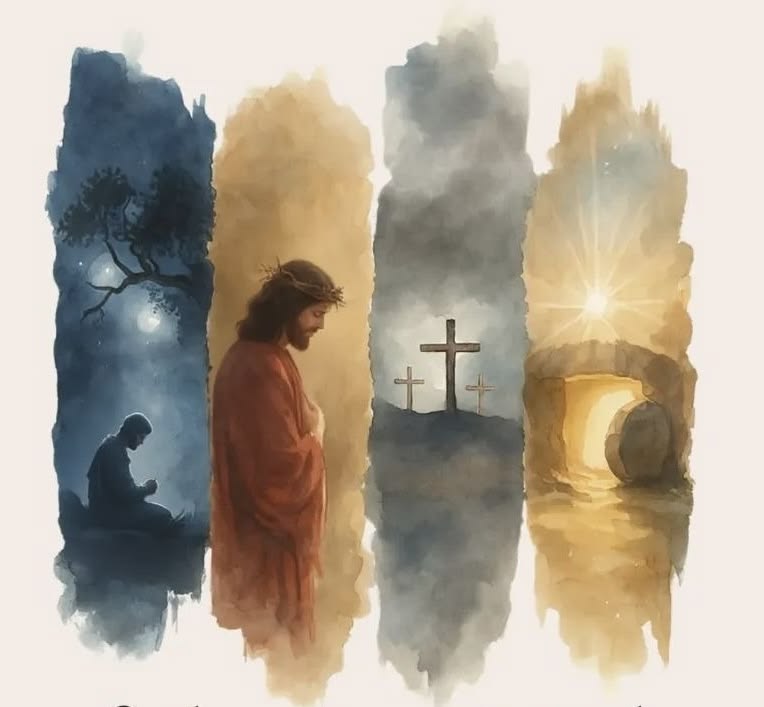
In the end, all of Holy Week points toward the Resurrection. Everything moves toward new life. Christianity is not the religion of the Cross alone; it is the religion of the Cross and the Resurrection. The Cross without the Resurrection would be tragedy; the Resurrection without the Cross would have no meaning. Together, they form the mystery of our salvation.
For this reason, during Holy Week, Christians should live with grateful and joyful hearts, because we know that Christ has conquered death and opened the gates of heaven for us.
This is the great truth we celebrate in these holy days, God loves us, Christ died for us, Christ is risen, and life has triumphed forever.